
Sri Lanka Transportation Guide: Tuktuk, Bus, Train & Private Transfer Explained
From personal experience, I know how daunting it can be at first to use public transport in a foreign country. On the one hand, you don’t know how public transport works, and on the other, you might have concerns about safety. I’ll make sure that you don’t have to worry about public transport on your first trip to Sri Lanka. I’ll explain how public transport by train and bus works, but I’ll also go into more detail about alternative transport options such as taxis and tuk-tuks.
How The Train Works In Sri Lanka
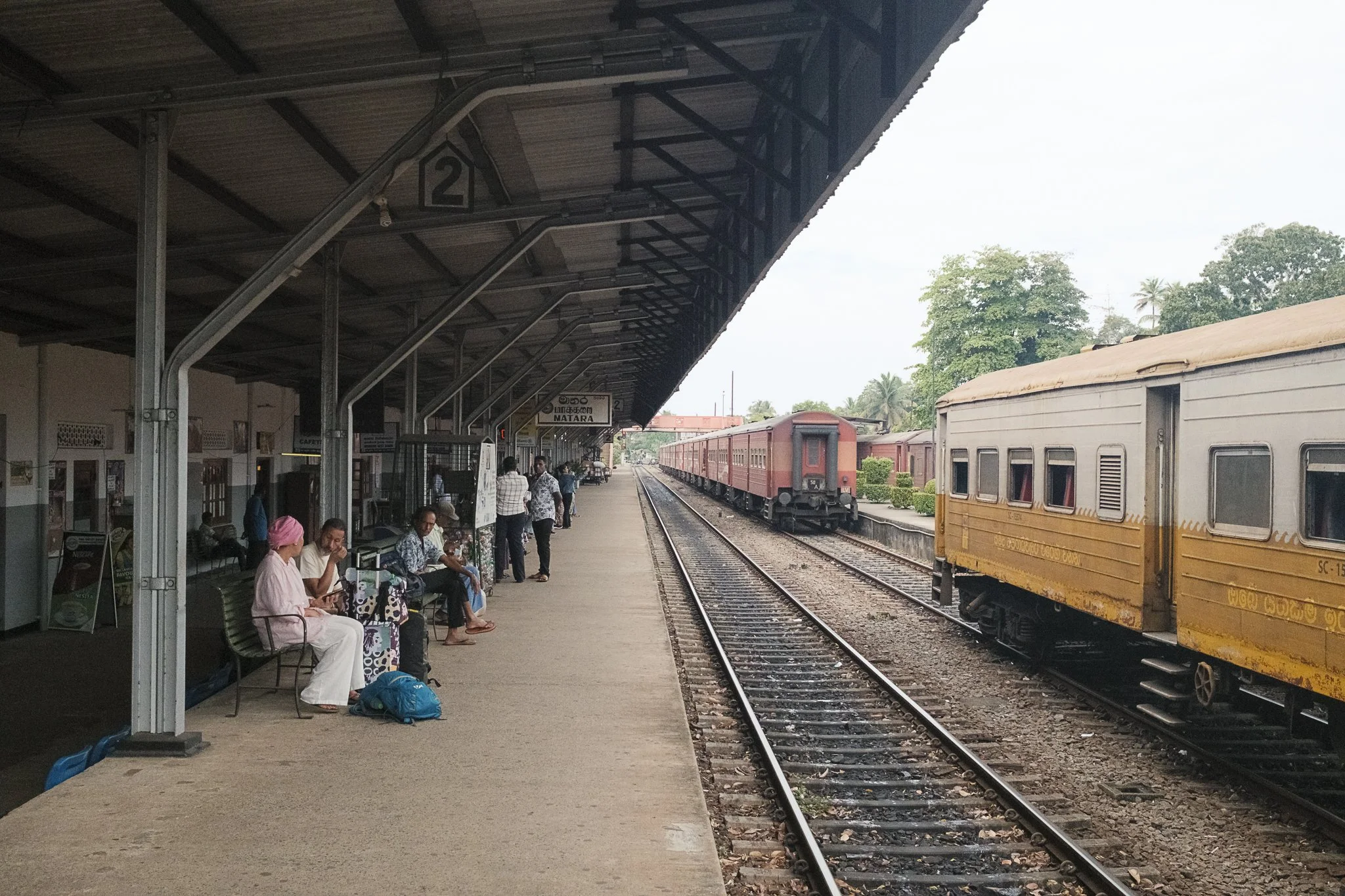
Oh, how I loved the train in Sri Lanka! I took the train from Matara back to Colombo Fort at the time, and it was one of the best experiences I had in Sri Lanka. Enjoying the journey whilst daydreaming, and driving past palm trees and villages along the coast, was simply breathtaking, and is something I will remember for the rest of my life.
In Sri Lanka, the trains are divided into three regions: the Colombo region, the Nawalapitiya region and the Anuradhapura region. For tourists, the most interesting routes are undoubtedly those from Colombo to the south coast, from Colombo to Kandy, and then from Kandy to Ella – or in the opposite direction.
There are three different classes on the trains: 1st class, 2nd class and 3rd class. Personally, I’d always recommend booking 2nd class. In my opinion, 2nd class offers the best experience. In 2nd class, there are padded seats, fans and the windows can be opened. What’s more, in 2nd class you’ll meet not only tourists but also the local people. In 1st class, there’s air conditioning – if it’s working – but you can’t open the windows. For these reasons, I wouldn’t recommend booking 1st class. You won’t be able to book 1st class for every route anyway, and you’d only be travelling with other tourists in the carriage, if anyone at all. I wouldn’t recommend third class either, even though it’s the cheapest option. There are only hard seats and, in all likelihood, not even any fans.
Trains in Sri Lanka don’t run regularly, which is why I recommend checking the timetable on the official Sri Lanka Railways website. You don’t need to buy your ticket in advance, nor do you need to reserve a seat, unless you decide to take the Kandy to Ella route, which is popular with tourists. I won’t go into detail about that here, as I haven’t travelled that route myself. At the time, I bought my ticket for the journey directly at the station. For the journey from Matara to Colombo, I approximately paid somewhere between 4$ and 6$, and the journey took about 4 hours. After payment you’re given a small ticket, which you have to show to a member of staff to gain access to the platform. On the south coast, it was relatively straightforward to find the right platform, as there’s only one platform in Matara and in other small towns along the south coast. I was glad I’d been able to get on the train at Matara, because by the time the train reached Weligama, the second-class compartments were already almost full.
I’d highly recommend taking the train at least once. In my opinion, the train is best suited if you have plenty of time. If you’re on the south coast, for example, the train is ideal for a trip to Galle or for the return journey to Colombo. However, I wouldn’t recommend taking the train back to Colombo if your flight is leaving on the same day. If you’d like to travel back to Colombo by train from the south coast, I’d recommend setting off a day early and staying overnight near the airport.
How The Local Bus System Works In Sri Lanka
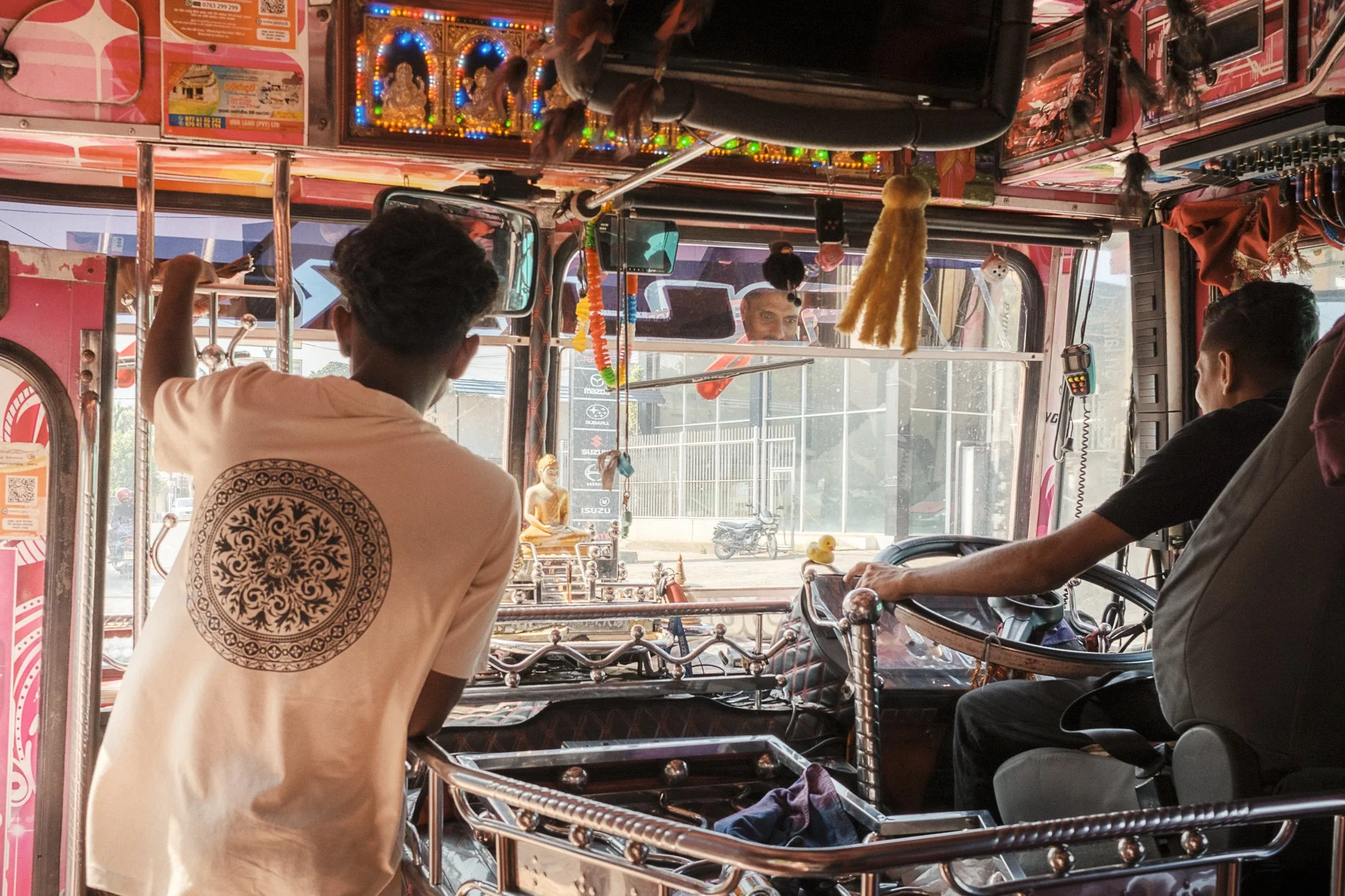
Open doors, colourful decorations and music – no two buses in Sri Lanka are alike. Just like the train, travelling by bus was an incredibly good experience. For short to medium distances, I really do recommend taking the bus in Sri Lanka. At first, I felt a bit too unsure to take the bus, as I didn’t know exactly how it worked or how safe a bus journey would be. But that won’t happen to you, as I’ll explain below how travelling by bus in Sri Lanka works.
Let’s start with how to actually catch a bus. You’ll find bus stops all along the main roads. Many bus stops are even marked as such on Google Maps. Buses run regularly from these stops, but you’ll need to make yourself known and signal to the driver that you want to board. There are no timetables for the buses, as they run very regularly – in Sri Lanka, the saying goes: “The faster bus wins”, and that’s exactly how they operate. The final destination is displayed on the buses. You should therefore find out in advance which direction your destination is in. For example, if the bus says “Weligama” and you want to go to Mirissa, you need to know beforehand that Mirissa is on the way to Weligama. Also it’s best to think in advance about roughly which bus stop you’d like to get off at, so that you can tell the bus conductor at the right moment when you want to get off. As you’re a tourist, you’re also welcome to ask the bus conductor whether you’re on the right bus and let them know in advance where you’d like to get off. In my experience, the bus conductors keep a close eye on you, as you’re definitely in the minority as a tourist on the bus.
Once you’ve found the right bus for you, you can simply get on and take a seat. To pay, the bus conductor will come to you and ask for the fare in cash. Important: cash only. I paid 100 LKR for my bus journey back then, which is the equivalent of about 30 cents. Depending on the length of the route, you might end up paying a bit more, but as you can see, the prices are quite low. For the same route, you’d pay up to 10 times as much in a tuk-tuk, depending on the journey.
To summarise once more: you absolutely must try the bus in Sri Lanka, and for me personally, it’s my preferred way of getting from one place to the next. You’ll find bus stops regularly along the main roads, and the buses are labelled with their final destination; you just need to know whether your destination is on the same route. Flag down the bus driver to signal that you want to get on, then get on the bus and take a seat. The conductor will come round to collect your fare and don’t forget to let the conductor know well in advance where you want to get off. Have fun!
How To Get A Tuk-Tuk In Sri Lanka
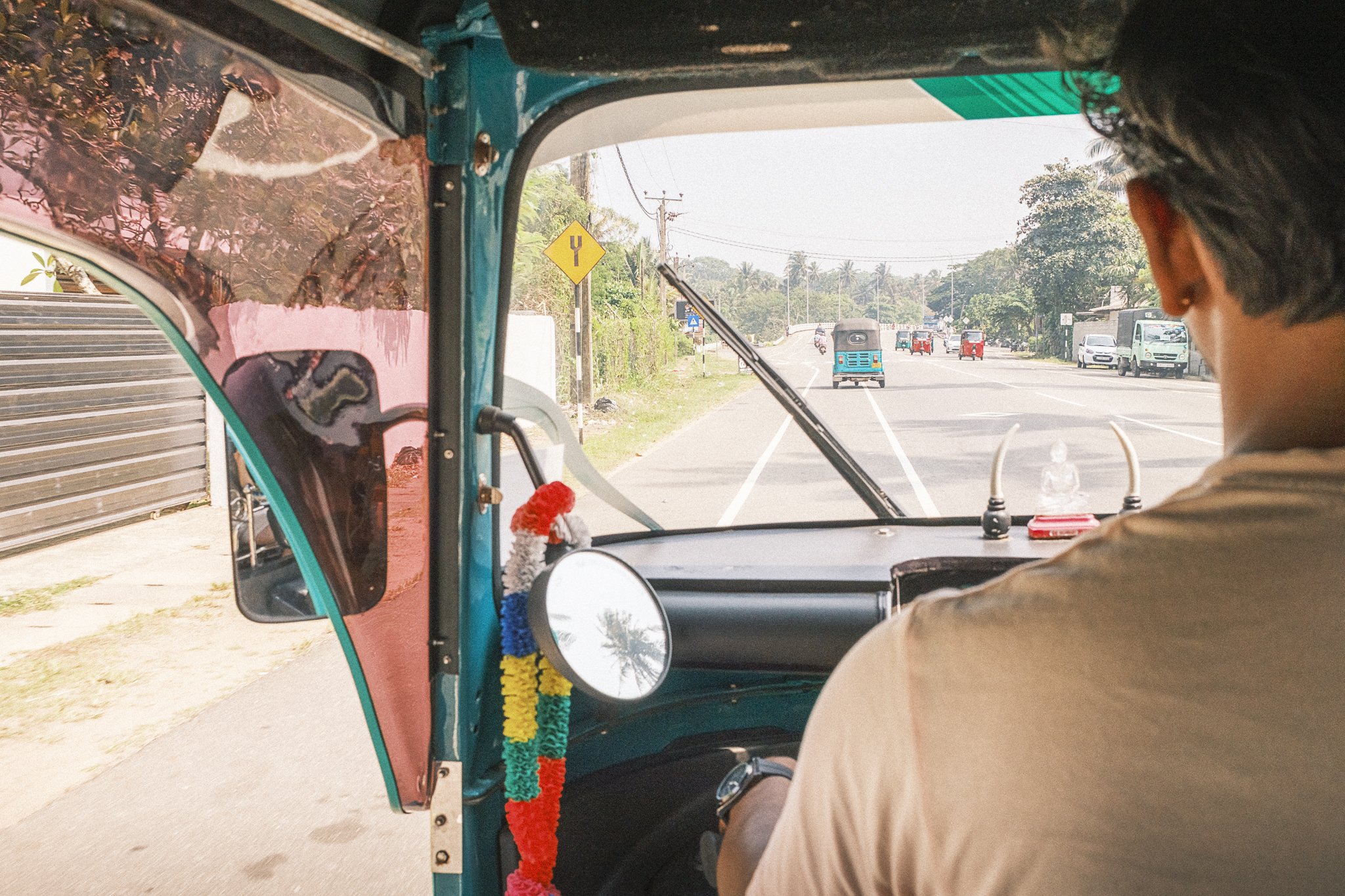
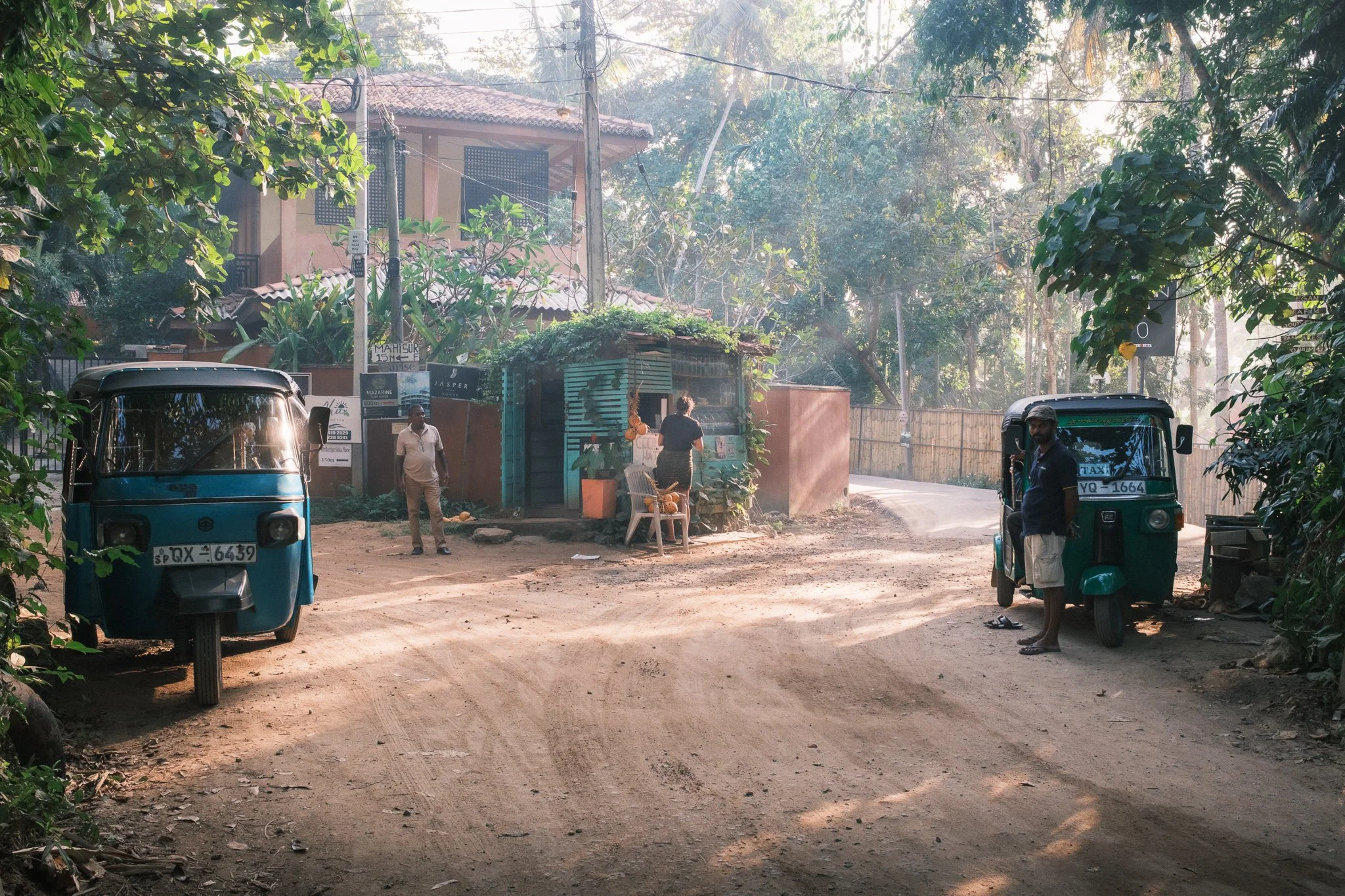
Another very common form of transport in Sri Lanka is the tuk-tuk. In my opinion, you can’t go to Sri Lanka and come home without having ridden in a tuk-tuk at least once. For me, the tuk-tuk is a bit like a “private transfer light”. It’s usually best suited to shorter distances, such as travelling from one town to the next. You can book a tuk-tuk via the PickMe app or haggle with one of the many drivers who can always be found waiting by the roadside. However, you’ll only have limited success using the PickMe app on the south coast because of the “tuk-tuk mafia”. If you really need a tuk-tuk, I recommend haggling with a tuk-tuk driver by the roadside. I always entered the route into the PickMe app beforehand and used the price shown there as my starting point for negotiating. Most of the time, though, you’ll have to pay a bit more than what’s shown in the app. That said, you can certainly be a bit more persistent and even hint that you’d like to negotiate with other drivers before making a decision – this usually gets you a better price – but please don’t overdo the haggling. It’s up to you, of course, how much you want to haggle, but I personally think it’s unnecessary to haggle over a few dollars or even cents. The prices aren’t generally too high.
As mentioned earlier, a tuk-tuk is usually worth it for short distances to get from one place to a neighbouring one. If you’ve never been in a tuk-tuk before, I’d recommend giving it a go at least once. Personally, though, I’d definitely prefer the bus to a tuk-tuk, as the experience of travelling by bus is simply worlds better than by tuk-tuk and, besides, much cheaper. For a journey of about 20 minutes, I paid between 2$ and 2.50$ for a tuk-tuk back in January 2026.
How Private Transfers Work In Sri Lanka
Booking a private transfer in Sri Lanka is the quickest and most convenient way to travel, but it’s also the most expensive. It’s quite easy to find a private transfer, as it’s a good way for locals to earn money. At the time, I booked my transfers via 12GO or on Google Maps. On 12GO, you can simply enter your route and date, filter by car type, and you’ll be shown offers from various taxi companies where you can compare prices. I also found another transfer via Google Maps, where I was able to conveniently send an enquiry via WhatsApp and negotiate the price. With this option, I recommend checking the prices on 12GO and using them as a basis for negotiating the price.
Other ways to book a transfer include the apps Uber, PickMe and Kangaroo. They all work in a similar way, but differ in terms of prices and customer support. During my trip, I only used PickMe once – to get from my hotel near the airport to Colombo Airport. In my experience, Uber and PickMe only work in Colombo. When I tried to use PickMe on the south coast, I was never able to book a driver. This is because there’s a sort of “tuk-tuk mafia” on the south coast. The tuk-tuk drivers who don’t use the PickMe app have banded together and prevent drivers on PickMe from picking up passengers. This is because the tuk-tuk drivers can charge passengers more money this way than they would receive via PickMe. I can’t really comment on Kangaroo personally, as I’ve never used it. However, I’ve read on several forums that many people prefer Kangaroo because the drivers are more reliable than those from Uber or PickMe. That said, the prices are apparently higher than with Uber and PickMe.
Ultimately, I’d advise you to book a private transfer if you want to get to your final destination as quickly and hassle-free as possible, if you’re travelling with a lot of luggage, or if you have to cover long distances. For a 3–4-hour journey, you should expect to pay between 60$ and 110$.
I hope I’ve managed to give you a reasonably good idea of what to expect from public transport in Sri Lanka. If you’ve read through this blog, you’ll definitely know more about public transport in Sri Lanka than I did back then. Don’t worry too much about it and just give it a go – it’ll all be fine.
Do you like the information I provide for free? A coffee is always appreciated. Thanks for being here.
Another blog post you might find interesting:
Another blog post you might find interesting: